
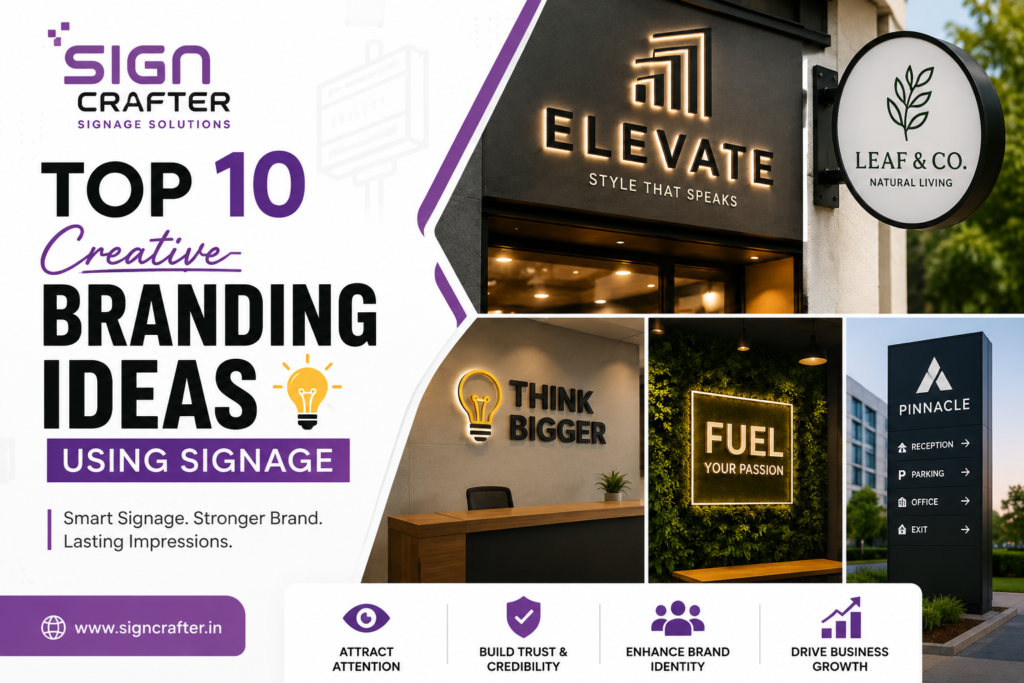
In a competitive marketplace, your brand needs to be visible before customers even walk through your door. While digital marketing, social media and advertising are important, physical signage remains one of the most powerful ways to showcase your brand in the real world.
A professionally designed sign does much more than display your business name. It communicates your brand personality, creates a first impression, attracts attention and helps customers recognize your business. Creative signage can become a physical extension of your brand identity.
Whether you own a retail store, restaurant, café, salon, clinic, showroom, startup or corporate office, the right signage can transform an ordinary space into a memorable brand experience. Business signage is increasingly being treated as a branding tool rather than simply an identification board.
In this guide, we explore 10 creative branding ideas using signage that businesses can use to strengthen their visual identity and stand out from competitors.
Why Is Signage Important for Branding?
Before exploring the ideas, it is important to understand why signage matters.
Your signage is often one of the first things customers see. A clear and attractive sign can help communicate:
- Your business name
- Brand colours
- Logo and identity
- Business personality
- Products or services
- Professionalism
- Location
- Promotional messages
A consistent signage system also helps customers recognize your brand across different physical locations and touchpoints.
The key is to design signage as part of your overall branding strategy, rather than treating it as an isolated board.
1. Create a Signature 3D Logo Sign
One of the most effective creative branding ideas using signage is a dimensional 3D logo.
Instead of printing your logo on a flat surface, convert it into raised letters or a three-dimensional logo. Materials such as acrylic, stainless steel, aluminium and other substrates can be combined to create different finishes.
3D acrylic signage is particularly useful for:
- Reception areas
- Shopfronts
- Showrooms
- Corporate offices
- Clinics
- Restaurants
- Retail stores
The added depth creates natural shadows and makes the logo visually prominent. Different finishes, layered acrylic and illumination can further customize the appearance.
Branding Tip
Keep your logo colours consistent with your website, packaging, social media and other marketing materials.
2. Use LED Backlit Signage for 24-Hour Branding
If you want your brand to remain visible after sunset, consider LED illuminated signage.
Backlit or halo-lit letters create a soft glow around the logo or text. Front-lit letters can provide stronger direct visibility, while edge lighting can create a more subtle premium effect.
LED signage is especially effective for:
- Restaurants
- Hotels
- Retail stores
- Salons
- Showrooms
- Clinics
- Corporate buildings
Modern acrylic and LED combinations can create highly visible branding during both daytime and nighttime.
Branding Tip
Don’t simply add bright lighting. Match the lighting colour and intensity with your brand personality. Premium brands may benefit from subtle illumination, while entertainment and retail businesses can use more expressive lighting.
3. Turn Your Reception Wall Into a Brand Statement
Your reception area is an excellent opportunity to communicate your brand.
Instead of installing a small nameplate, create a branded reception wall featuring your company logo, tagline and complementary design elements.
Popular options include:
- 3D acrylic letters
- Stainless steel letters
- Backlit logos
- Layered acrylic logos
- Metal finishes
- LED neon-style branding
- Custom wall graphics
Reception branding can make an office feel more professional and give visitors an immediate understanding of the company they are entering. Current office branding solutions commonly combine dimensional logos with acrylic, metal and illumination.
Branding Tip
Keep your reception wall visually clean. Your logo should remain the main focal point.
4. Use Your Shopfront as a Branding Canvas
Your storefront is one of your most valuable physical marketing assets.
Instead of using the shopfront only for your business name, use the available space to communicate your brand personality.
You can combine:
ACP elevation + 3D letters + LED lighting + window graphics + brand colours
For example, a fashion store could use elegant dimensional letters and premium finishes, while a children’s store could use colourful graphics and playful typography.
A good shopfront should help customers identify your business quickly from the street.
Branding Tip
Design your signage based on the viewing distance. A beautiful sign is ineffective if customers cannot read it from the road.
5. Create Branded Window Graphics
Don’t ignore your windows.
Glass surfaces can become powerful branding areas using professionally designed window graphics and vinyl applications.
You can use them to display:
- Brand messages
- Product categories
- Promotional offers
- Opening hours
- Services
- Social media handles
- Creative graphics
Window graphics can also help transform an otherwise plain storefront into a visually attractive brand environment.
Branding Tip
Avoid covering every inch of glass. Use strategic graphics while maintaining visibility into and out of the premises.
6. Use Branded Indoor Signage Throughout Your Business
Branding should not stop at the entrance.
Carry your visual identity throughout your business using indoor signage.
For example, a corporate office could use branded signage for:
- Reception
- Meeting rooms
- Departments
- Employee areas
- Directional signs
- Visitor information
- Safety information
Use consistent fonts, colours, icons and materials throughout the space.
This creates a cohesive brand experience and makes the entire premises feel professionally designed.
Branding Tip
Create a simple signage guideline covering your approved colours, typography, logo usage and materials. This is particularly important when branding multiple locations.
7. Turn Signage Into an Instagram-Worthy Photo Spot
Modern customers don’t just see brands—they photograph and share them.
Create a photo-friendly branded wall or signage installation that customers naturally want to photograph.
Ideas include:
- Illuminated logo walls
- Creative neon-style signs
- 3D brand statements
- Artistic typography
- Custom hashtag signs
- Branded selfie walls
- Creative product displays
A well-designed photo spot can encourage customers to share their experience on social media, giving your physical branding additional digital exposure.
Branding Tip
Include your logo naturally in the design rather than making the display look like a traditional advertisement.
8. Add QR Codes to Your Physical Signage
One of the smartest ways to connect offline branding with digital marketing is by adding QR codes to signage.
A QR code can direct customers to:
- Your website
- Google Business Profile
- Product catalogue
- Online menu
- Social media
- Booking page
- Customer feedback form
This transforms a static sign into a digital customer touchpoint.
For example, a restaurant can place a QR code on its outdoor sign that takes customers directly to the digital menu.
Branding Tip
Don’t make the QR code the main visual element. Place it neatly within the design and include a short call-to-action such as “Scan to Explore”.
9. Use Creative Typography to Build Brand Recognition
Typography can become a major part of your visual identity.
Instead of choosing a generic font, consider custom lettering that reflects your brand personality.
For example:
Luxury Brand: Elegant and refined typography
Technology Brand: Clean and geometric typography
Restaurant: Distinctive and inviting lettering
Kids Brand: Playful typography
Corporate Brand: Professional and minimal typography
Custom typography can make your signage instantly recognizable.
Creative signage doesn’t necessarily mean adding more graphics. Sometimes, strong typography alone can create a powerful visual identity. The renewed interest in distinctive, handcrafted and custom sign lettering also shows how typography can give physical branding a unique character.
Branding Tip
Always prioritize readability. Your font should look attractive but remain easy to read from the intended viewing distance.
10. Combine Multiple Signage Materials
A creative way to make your branding more distinctive is to combine different materials.
Instead of using only one material, consider combinations such as:
- Acrylic + ACP
- Acrylic + Stainless Steel
- Wood finish + Acrylic
- Metal + LED
- ACP + 3D letters
- Acrylic + Vinyl
- Metal + Backlighting
Different textures create depth and visual contrast.
For example, a premium showroom could use a metallic logo mounted over an architectural ACP background with subtle LED illumination.
The result is more than a signboard—it becomes part of the building’s visual design. Modern commercial signage increasingly combines materials, dimensional letters and illumination to create distinctive storefronts and branding installations